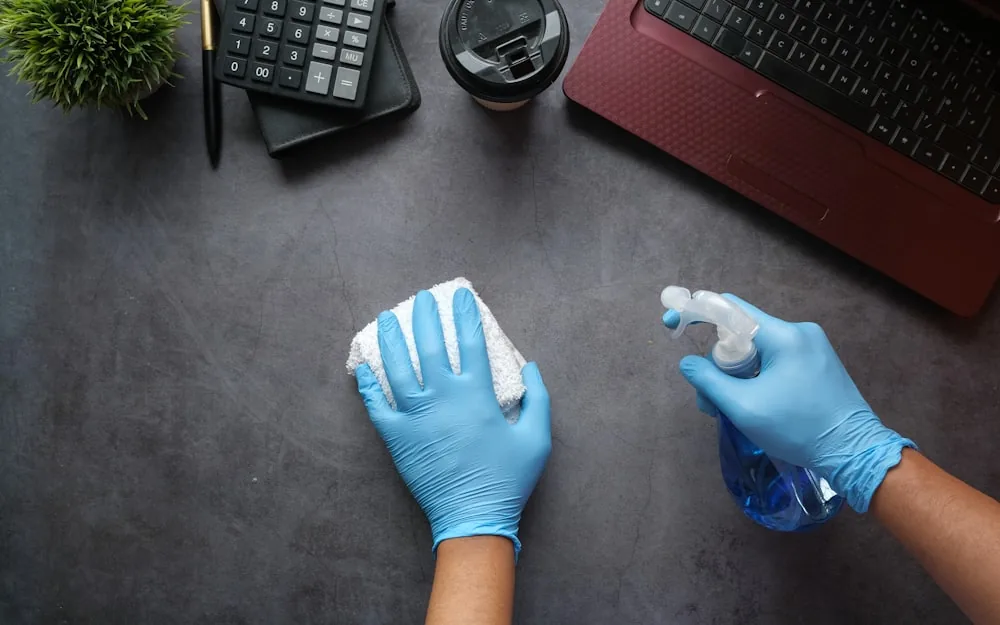
Hand hygiene and touch point cleaning have reasonable evidence behind them for reducing transmission of respiratory and gastrointestinal illness in shared settings. The specific claim that a cleaner office produces a measurable reduction in your company's sickness absence figures is much weaker, and most of the dramatic statistics circulated by cleaning companies do not survive scrutiny.
This is an article about cleaning written by a cleaning company, so it is worth being straight about that. The case for cleaning an office well is solid. The case usually made for it is not.
What sickness absence actually costs
The Office for National Statistics has recorded UK sickness absence rates of around 2.6%, the highest since 2004. That figure covers everything: minor illness, musculoskeletal problems, mental health, chronic conditions and injuries.
Minor illness, meaning coughs, colds and stomach upsets, is consistently the single largest reported category. That is the portion where hygiene measures could plausibly have any effect, and it is a minority of total absence rather than the whole of it.
Any claim that cleaning will reduce your total absence figure by a large percentage is ignoring the fact that most absence has nothing to do with surface hygiene.
The statistics you should be sceptical of
Three claims circulate endlessly in cleaning industry marketing. All three deserve examination.
"The average desk has 400 times more bacteria than a toilet seat." This traces back to work by microbiologist Dr Charles Gerba. The underlying observation is real: toilet seats are cleaned frequently with disinfectant, desks are not, so desks carry more bacteria. But bacterial count is not the same as pathogen risk. Most of what is on a desk is harmless skin and environmental flora. The comparison is memorable rather than meaningful, and it has been repeated for two decades without much scrutiny.
Precise germ counts per square inch. Figures like "20,961 germs per square inch" get repeated as though they were a standard measurement. They come from small commercial surveys, not peer-reviewed surveillance, and the numbers vary enormously by method, surface, and time since last cleaning.
"Hot desking increases sickness absence by 62%." This kind of figure typically comes from a self-reported survey rather than a controlled study. Self-reported survey data cannot separate desk sharing from the many other things that differ between organisations that hot desk and those that do not, such as sector, office density, commuting patterns and sick leave policy.
None of this means offices should not be cleaned. It means the honest argument is different from the marketed one, and a contractor who leads with these numbers is telling you something about how they sell.
What the evidence does support
Hand hygiene works. This is the best supported intervention by a distance. Accessible soap, working hot water, and hand drying facilities that people actually use reduce transmission of respiratory and gastrointestinal illness. If you do one thing, make sure washrooms never run out of soap and paper.
Touch point cleaning is reasonable and proportionate. Shared surfaces touched by many hands, door handles, push plates, lift buttons, kitchen taps, shared keyboards and printer panels, are a plausible transmission route. Cleaning them regularly is cheap and sensible.
Cleaning before disinfecting matters. Disinfectant applied to a soiled surface and wiped straight off does very little. Detergent first to remove soil, then disinfectant left wet for its stated contact time, usually thirty seconds to five minutes. Most workplace disinfection is done wrong in exactly this way.
Ventilation matters more than surfaces for respiratory illness. This became much better understood after 2020. For airborne transmission, air changes do more than any amount of surface cleaning. If you are trying to reduce respiratory illness in an office, ventilation and staying-home policies outrank cleaning.
Washroom standards affect behaviour. People wash their hands less in unpleasant washrooms. That is an indirect but real mechanism, and it is entirely within a cleaning contract's control.
The honest business case
Cleaning an office well is worth doing for reasons that do not require inflated statistics.
It is a legal duty. Under the Workplace (Health, Safety and Welfare) Regulations 1992, employers in Great Britain must keep workplaces and their furnishings sufficiently clean and remove waste appropriately, and must provide suitable washing facilities. This is not optional.
Staff read it as a signal. The state of the kitchen and washroom tells people how the organisation regards them. That affects morale and retention, which cost far more than cleaning does.
Clients judge reception and washrooms. Reliably, and often unconsciously.
Buildings degrade without periodic maintenance. Carpets and hard floors that are never deep cleaned need replacing years earlier. That is a straightforward asset cost with a clear payback.
Marginal illness reduction is plausible even if unmeasurable. Sensible hygiene probably reduces some transmission. You will not be able to attribute it in your absence data, and you should be suspicious of any contractor who promises you will.
What to actually prioritise
If you want the hygiene benefit rather than the appearance benefit, the order is:
- Washroom consumables, never out of stock. Soap, hot water, drying
- Touch points daily, cleaned properly with the correct contact time
- Kitchen surfaces and shared appliances, the highest-risk shared space in most offices
- Ventilation, which is not a cleaning contract item but outranks most of them
- A culture where people stay home when ill, which outranks everything on this list
That final point is uncomfortable for a cleaning company to write, and it is true. Presenteeism drives more workplace transmission than any surface. No cleaning specification compensates for a culture where people come in with a fever because they feel they have to.
Specifying it properly
If hygiene is the objective, write it into the specification explicitly:
- Touch points listed by name, not as a category
- Daily frequency
- Detergent-then-disinfectant method with stated contact times
- A consumables restocking process with a named escalation route
- Kitchen surfaces and appliance touch points specified separately from general cleaning
A generic specification that says "clean office" will produce an office that looks clean. If you want the touch points done properly, name them individually, because what is not specified does not get measured and what is not measured does not get done.
Frequently asked questions
Will cleaning reduce our sick days? Possibly at the margin, but not measurably, and anyone promising a specific percentage is selling rather than informing.
Is antibacterial cleaning necessary in an office? Detergent handles routine cleaning. Disinfect touch points and after known illness. Routine heavy disinfection of everything is not necessary and not supported.
What about fogging or misting? Not appropriate as routine practice in a normal office, and the evidence for benefit over conventional cleaning is weak.
Do air purifiers help? They help with airborne particles as a supplement to ventilation, not as a replacement for it. Ventilation first.
Should we clean during the day so staff see it? It reassures people and has some value, but it costs more. Decide whether you are buying hygiene or visible reassurance, since they are different products.