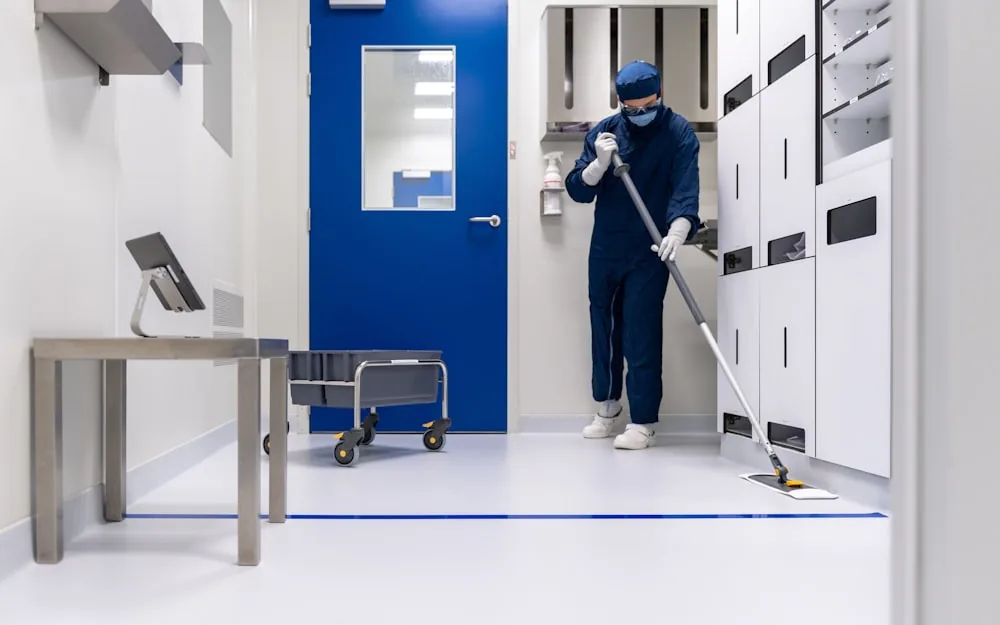
Cleaning a salon, clinic or dental surgery is not office cleaning done more carefully. It is a different discipline with different equipment, documented methods and, in regulated settings, an inspection regime that expects to see records.
If you run one of these premises, the practical consequence is that a general office cleaning contractor may not be the right supplier, and a contract written like an office contract will not cover what you need.
What changes
Colour coding. Cloths, mops and buckets are colour coded by area so equipment never moves between zones. The widely used convention is red for washrooms and sanitary areas, blue for general low risk areas, green for kitchens and food preparation, and yellow for clinical and infection control areas.
The point is preventing cross-contamination, and it only works if it is enforced rather than nominally adopted. That means buying enough equipment that nobody is ever tempted to reuse the wrong cloth because the right one is in the wash.
Contact times, enforced. Disinfectants have a stated contact time, typically thirty seconds to five minutes. In a clinical setting this is not advisory. Spraying and immediately wiping is the most common failure in practice, and it means the disinfection did not happen.
Clean before you disinfect. Detergent removes soil and the organic matter that neutralises disinfectants. Disinfectant on a soiled surface achieves very little. Two steps, in order, every time.
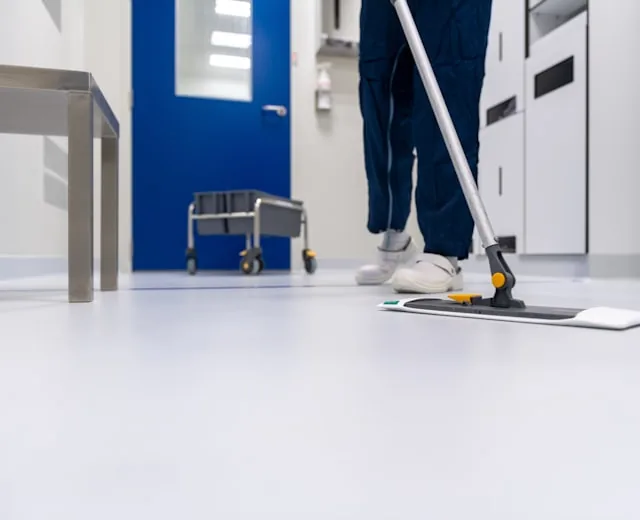
Two-stage or dedicated mopping. Single-bucket mopping redistributes soil. Clinical settings use two-bucket systems, dedicated mop heads per area, or disposable heads changed between rooms.
Documentation. Cleaning schedules signed and dated at the time, product safety data sheets available, staff training recorded, and audit results kept. In regulated settings, if it is not recorded it did not happen as far as an inspector is concerned.
Zoning and direction of work. Always clean from clean areas toward dirty ones, never the reverse, and never carry equipment backwards through that flow.
By sector
Dental practices
The most heavily regulated of the three. Practices in England work to national decontamination guidance covering the separation of clean and dirty flows, surgery cleaning between patients, and the decontamination room.
Cleaning contractors typically handle the general practice environment rather than instrument decontamination, which stays with clinical staff. That division needs to be explicit in the specification, because ambiguity here is a genuine compliance risk.
Expect requirements around zoning, documented schedules, appropriate disinfectants and evidence of training. The Care Quality Commission inspects, and cleanliness and infection control is among the areas examined.
GP surgeries and private clinics
Waiting rooms, consulting rooms, treatment rooms and washrooms all carry different requirements. Consulting room surfaces, couches and touch points need cleaning between patients, which is usually clinical staff, with the contractor covering scheduled deeper cleaning.
Clinical waste is segregated and disposed of under a separate licensed process with waste transfer documentation. A general cleaning contractor should not be handling it unless they are specifically set up and licensed to.
Specify frequency by area, with treatment rooms higher than reception, and specify what happens with a bodily fluid spillage including the kit location and the method.
Beauty salons and aesthetic clinics
Local authority licensing usually applies for treatments involving skin piercing, and requirements vary by council, so check with your own environmental health team rather than assuming.
Common expectations include cleanable, non-porous surfaces, hand washing facilities, appropriate waste segregation for sharps where used, and documented cleaning procedures.
Practically: couches and chairs wiped between clients, floors cleaned frequently because hair and product accumulate fast, basins and backwash units descaled regularly, and towels laundered at appropriate temperatures.
Hairdressers
Lower regulatory burden but high soiling. Hair gets everywhere and into everything, including drains and equipment.
Backwash basins need frequent descaling, floors need sweeping between clients as well as proper cleaning, and drainage needs regular attention or it blocks. Colour products stain, so surfaces and floors need prompt attention rather than end-of-day cleaning.
What to specify
Beyond the standard office scope, a specification for these premises should name:
- Colour coding system in use, and how it is enforced
- Products used, with safety data sheets, and evidence they are appropriate for the setting
- Contact times for each disinfectant, written into the method
- Zoning: which areas are cleaned in which order, always clean to dirty
- Frequency by area, with treatment rooms higher than circulation space
- Waste handling, and explicitly what the contractor does and does not touch
- Recording: a signed schedule, retained for a stated period
- Staff training, its content and refresh frequency
- DBS checks where appropriate
- Procedure for a spillage of blood or bodily fluids, including the kit and the method
- Laundry arrangements for towels and gowns, if included
Common failures
From what tends to go wrong in practice:
Equipment crossing zones. The mop that did the toilet doing the treatment room. Colour coding fails when there is not enough equipment, so buy enough.
Contact times ignored because the cleaner is behind schedule. This is a resourcing problem disguised as a compliance problem. If the hours do not allow for contact times, the specification is not deliverable and needs repricing rather than rushing.
Records completed retrospectively. A schedule signed for a whole week on a Friday is worse than no schedule, because it is documentary evidence of a system that is not working.
Reception prioritised over treatment areas because it is what clients see. Understandable and exactly backwards.
General office contractors taking on clinical work without the training or documentation, usually because it was quoted as an office.
Storage of chemicals in clinical areas rather than a dedicated locked store.
Choosing a contractor
Ask everything you would ask a commercial contractor, plus:
- Have you cleaned this type of premises before, and can I speak to that client?
- What is your colour coding system and how do you enforce it?
- Can I see a sample cleaning schedule and audit record from a similar site?
- How do you train staff on infection control, and how often is it refreshed?
- What is your procedure for a bodily fluid spillage?
- Are your staff DBS-checked, and at what level?
- Will the same staff attend each time?
- How do you handle waste, and what do you not touch?
That penultimate question matters more here than anywhere. In a regulated setting, a cleaner who knows the zoning, the products and the schedule is a control measure. A different person each week is a risk.
Records to keep
- Signed and dated cleaning schedules, completed at the time
- Audit records with dates and findings
- Training records for every operative attending
- COSHH assessments and safety data sheets
- Waste transfer notes
- Incident records, including spillages
- Contractor insurance certificates and RAMS
Retention periods vary by sector and regulator, so check your own requirements, but two years is a common working minimum.
Frequently asked questions
Do I need a specialist cleaning contractor? For dental and medical, generally yes. For salons, a good commercial contractor with the right training and documentation is usually sufficient.
Who cleans between patients? Normally clinical staff, with the contractor doing scheduled and deeper cleaning. Make the split explicit in writing.
What disinfectant should be used? One appropriate to the setting and the organisms of concern, used at the correct dilution and contact time. Take the specification from your own clinical governance rather than from a cleaning company.
Are cleaners allowed to handle clinical waste? Only if specifically trained and set up for it, with the correct documentation. Most general cleaning contracts exclude it.
How often should treatment rooms be deep cleaned? In addition to between-patient cleaning, a scheduled deep clean is common weekly or monthly depending on use. Set it against your own risk assessment.