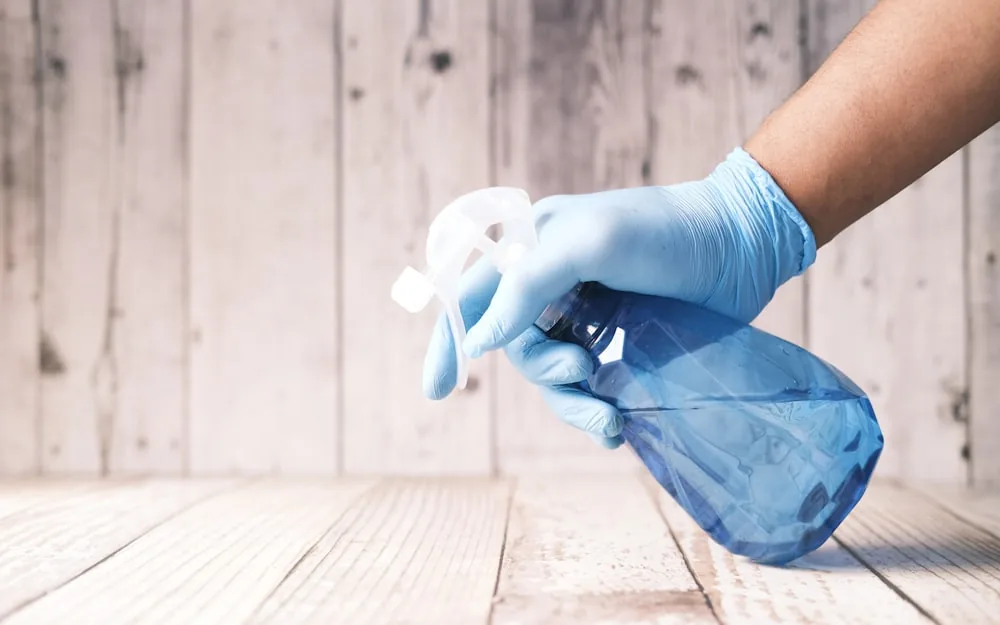
Focus on high touch surfaces and textiles, not floors and walls. Clean first with detergent, then disinfect, and leave the disinfectant wet for the contact time on the label. That last step is the one almost everybody skips, and skipping it means the disinfectant has not done what the bottle claims.
Most respiratory illness spreads through the air and through hands touching shared surfaces. That tells you where to spend the effort: the things hands touch dozens of times a day, and the fabrics someone has been lying in for a week.
Cleaning and disinfecting are two different steps
They are not interchangeable, and the order matters.
Cleaning uses detergent to physically remove soil, grease and a large share of the microorganisms sitting in it. It is a mechanical process.
Disinfecting uses a chemical to kill what remains. It only works properly on a surface that has already been cleaned, because organic matter, grease and dust neutralise most disinfectants before they reach anything.
Spraying disinfectant onto a dirty surface and wiping it straight off achieves very little. Detergent first, then disinfectant, then leave it wet.
Contact time is the bit people miss
Every disinfectant has a contact time printed on the label, typically between thirty seconds and five minutes. That is how long the surface must remain visibly wet for the product to work as tested.
Spraying and immediately wiping gives a contact time of about two seconds.
If you take one thing from this article, make it this: spray, walk away, come back. It costs nothing and it is the difference between disinfecting and pretending to.
The surfaces that matter
Work through these rather than the whole house.
Touched constantly
- Door handles, both sides, and the plate around them
- Light switches
- Bannister and stair rail
- Taps, in every room
- Toilet flush handle or button
- Fridge and cupboard handles
- Kettle handle and switch
- Remote controls
- Phones, tablets and laptop keyboards
- Car keys and house keys
- Games controllers
Bathroom
- Toilet seat, lid, flush and the wall around it
- Basin and taps
- Bathroom door handle, inside and out
- Towel rail
- Toothbrush holder, which is grim and never cleaned
Kitchen
- Worktops
- Sink and taps
- Bin lid, and the pedal
- Anything shared during the illness: mugs, the kettle, the fridge door
Floors and walls are a very low priority. They are not where transmission happens in a household, and the time is far better spent on the list above.
Textiles
This is the other half of the job, and often the more important one.
- Bedding used during the illness: wash at the hottest temperature the fabric allows, ideally 60°C. Do not shake it out before washing, which just puts particles into the air. Carry it to the machine in a bag or basket rather than held against you
- Towels, the same. Give the ill person their own towel during and immediately after
- Pyjamas and clothing worn while unwell
- Cushion covers and throws from wherever they convalesced on the sofa
- Soft toys, if a child has been ill, either machine washed or bagged for a few days
- Dressing gown, which everyone forgets
Dry laundry thoroughly. Damp textiles create their own problem.
Air
Ventilation does more than any spray. Open windows for as long as is practical, ideally creating a through draught in the affected rooms for fifteen to thirty minutes at a time.
In winter, short bursts of wide-open windows work better than leaving one window slightly ajar all day, and they lose less heat, because you exchange the air quickly rather than cooling the fabric of the building.
Air purifiers with HEPA filters help with particles but are a supplement to ventilation rather than a replacement for it.
Timing
Wait until the person is recovered before doing the full clean, unless something obviously needs dealing with immediately. Cleaning around someone who is still ill means doing it twice, and it exposes you unnecessarily.
Do the high touch surfaces daily during the illness. Do the full reset afterwards.
Safety points
- Ventilate while using disinfectants, and never mix them. Bleach with acidic cleaners such as limescale remover releases chlorine gas. Bleach with ammonia is also dangerous. Both cause hospital admissions every year
- Wear gloves, and wash your hands afterwards regardless
- Use disposable cloths, or wash reusable ones hot after this kind of clean, since a contaminated cloth spreads exactly what you are trying to remove
- Do not use disinfectant wipes on screens. Use a cloth lightly dampened with 70% isopropyl alcohol, and check your device manufacturer's guidance
- Bleach is not appropriate on every surface. It damages stainless steel over time, discolours many worktops and fabrics, and should never go on natural stone
- Check dilution. Concentrated products are diluted for a reason, and stronger is not better
What is not worth doing
- Fogging or misting whole rooms. Not appropriate or necessary in a domestic setting
- Cleaning walls and ceilings. Very low yield for the effort
- Throwing away mattresses or upholstery. Vacuum thoroughly, ventilate and wash the covers
- Antibacterial everything, permanently. Routine heavy disinfectant use in a normal household is unnecessary, and detergent and hot water handle everyday cleaning perfectly well
- Replacing toothbrushes constantly. Replace the ill person's one, once, afterwards
Norovirus is different
Winter vomiting bugs deserve a specific mention, because alcohol hand gels do not work well against norovirus and it survives on surfaces for a long time.
- Clean the affected area with detergent first, then use a bleach-based product at the dilution the label specifies for that purpose
- Wash contaminated laundry separately at the highest temperature the fabric allows
- Wash hands with soap and water rather than relying on hand gel
- Keep the affected person's towel separate
- Expect to keep disinfecting high touch surfaces for a couple of days after symptoms stop, since shedding continues
- Do not vacuum vomit. Absorb, remove, then clean and disinfect
- Ventilate, since aerosolised particles from vomiting travel further than people expect
If someone in the house is immunosuppressed
The principles are the same but the discipline matters more. Prioritise ventilation, keep high touch cleaning daily rather than occasional, be strict about contact times, and be more cautious about visitors than feels socially comfortable. Speak to the relevant clinical team about anything specific to their condition, since general household advice is not a substitute for that.
Frequently asked questions
How long do germs survive on surfaces? It varies enormously by organism, surface and conditions. Rather than trying to time it, clean the surfaces that matter and move on.
Do I need a special disinfectant? A standard household disinfectant used correctly, with its stated contact time, is sufficient for most situations. Norovirus is the exception, where a bleach-based product is preferred.
Should I clean during or after the illness? High touch surfaces during, full reset after.
Does steam cleaning work? It can be effective on some surfaces but is not a substitute for the detergent-then-disinfectant sequence on high touch points, and it is not appropriate on many household materials.
What about pets? Most human respiratory illnesses do not transmit to pets, but wash pet bedding as part of the general reset and keep disinfectants away from areas where pets lick.