Twenty minutes at the end of each day prevents almost all of the accumulation that makes weekend cleaning feel enormous. The reason it works is not the cleaning itself, it is that mess compounds. A cup left out becomes four cups by the following evening, and by Saturday the kitchen is a project rather than a job.
Here is the sequence, in the order that makes it fastest.
The routine
Minutes 1 to 5: kitchen surfaces
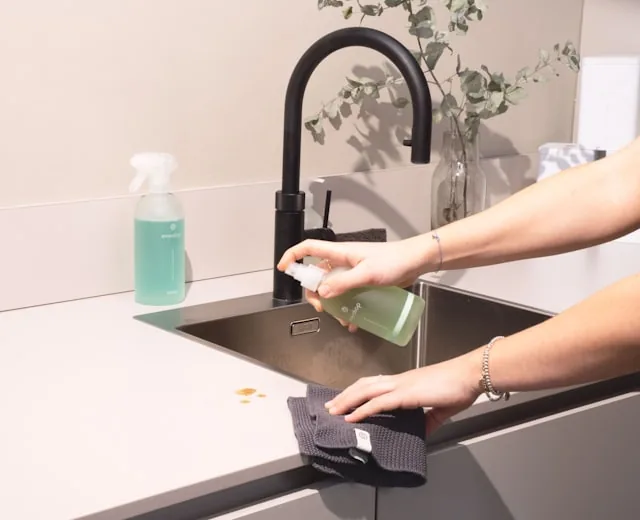
Clear the worktops completely. Load or run the dishwasher, or wash what is there. Wipe the worktops and the hob while it is still warm. Rinse the sink and dry the taps.
Minutes 6 to 9: the sweep
Walk through the house with a basket or laundry bag and collect everything that is not where it lives. Do not put things away as you go, which is the slow way. Collect first, distribute second.
Minutes 10 to 13: distribute
Empty the basket, room by room. Clothes to the wash or the wardrobe, post to one place, toys to their box, shoes to the rack.
Minutes 14 to 16: bathroom
Wipe the basin and taps. Squeegee the shower screen if anyone showered. Straighten the towels. Put the bathmat over the rail to dry.
Minutes 17 to 18: floors
A quick vacuum or sweep of the kitchen and the main walkway only. Not the whole house.
Minutes 19 to 20: set up tomorrow
Bins out if full. Anything you need in the morning by the door. Curtains, lights, done.
Why the order matters
The kitchen comes first because it is the room that most affects how the whole house feels the next morning, and because a clear worktop makes everything else easier.
Collecting before distributing is the biggest single time saving in the routine. Walking room to room putting individual items away means covering the same ground fifteen times. Collect everything in one circuit, then distribute in a second.
Floors come last because everything above them has already been dealt with, so you are not sweeping twice.
The squeegee takes fifteen seconds and prevents essentially all limescale film on a shower screen, which is otherwise one of the most tedious jobs in a house, particularly in a hard water area.
What is deliberately not in it
- Dusting
- Bathrooms beyond a wipe
- Bedrooms beyond collecting clothes
- Anything requiring a product other than a general spray
- Anything you have to move furniture for
- Anything that takes more than a minute to think about
Those belong in the weekly clean. Trying to include them is exactly why daily routines get abandoned in week two. The daily reset is about preventing accumulation, not about cleaning.
Making it actually happen
Attach it to something fixed. After dinner, or after the children are in bed, or while the kettle boils for a last cup of tea. Routines that float never happen.
Set a timer. Twenty minutes is short enough to start when you do not feel like it, and the timer stops it expanding into an hour.
Do it with someone. Two people at ten minutes each is the same work and roughly four times more likely to happen.
Music or a podcast. Trivial advice, but the completion rate difference is real.
Accept a partial version. Ten minutes of the kitchen alone is worth far more than skipping it entirely because you cannot face the full twenty. The perfect version done twice a week is worse than the half version done daily.
Keep the tools accessible. A cloth under the sink, a spray within reach, the vacuum somewhere you do not have to unbury it. Friction kills routines.
The one-touch rule
The habit that reduces the twenty minutes to about twelve: when you pick something up, put it where it belongs rather than somewhere else.
Post goes to the paperwork spot, not the kitchen table. A coat goes on the hook, not the bannister. A mug goes in the dishwasher, not next to the sink.
Most household mess is not dirt. It is objects that have been moved to a temporary location and left there. Every temporary location becomes a pile, and every pile takes ten times longer to deal with than the original object would have.
The morning version
If evenings are impossible, a ten minute morning version works nearly as well:
- Make the bed
- Clear and wipe the kitchen worktop
- Wipe the bathroom basin
- Squeegee the shower
- Put yesterday's dishes away
Coming home to a made bed and a clear worktop measurably changes how the evening goes, which is a small thing that turns out to matter more than it sounds.
Adapting it to your household
With young children: add a five minute pack-down before bed where everything on the floor goes into a box. Not sorted, just cleared. A clear floor is worth more than an organised toy box.
With pets: add a quick sweep or vacuum of their main area, and wipe paws at the door in winter.
Working from home: the kitchen gets three times the use, so the first five minutes matter more, and you may want a short midday version too.
In a shared house: the daily reset only works if everyone does their own. The alternative is one person doing it for everyone, which lasts about three weeks before resentment sets in.
In a very small flat: the whole routine takes closer to twelve minutes, and it matters more, because there is nowhere for mess to be out of sight.
How this changes your weekly clean
A house that gets a daily reset needs roughly half the weekly cleaning time of one that does not, because the weekly clean is then genuinely just cleaning rather than a combined tidying and cleaning operation.
This is also the single biggest thing you can do to get value from a paid cleaner. Cleaners clean surfaces, and surfaces covered in belongings cannot be cleaned. A house that has been reset daily gets substantially more actual cleaning out of the same booked hours.
What it does not fix
Be clear about the limits. The daily reset keeps a home tidy and stops accumulation. It does nothing about limescale, the oven, grout, dust on light fittings or carpets, because those degrade on a scale of months regardless of how tidy you are.
You still need a weekly clean and a deep clean once or twice a year. What the daily reset does is make all of those jobs smaller, and make the house pleasant to be in between them.
Frequently asked questions
Is twenty minutes really enough? For preventing accumulation, yes. It is not a substitute for weekly cleaning.
What if I miss a day? Nothing bad happens. Miss four and you will feel it. The routine is forgiving of occasional gaps and unforgiving of abandonment.
Should I do it before or after dinner? After, so the kitchen is dealt with in one pass rather than two.
Does this work in a big house? The principle does, but budget thirty minutes rather than twenty, and restrict the floor pass to the main routes.
What if my household will not join in? Do your own areas and the shared kitchen. A one-sided reset still prevents most of the accumulation, though it is worth having the conversation.